Liberation Dance

Photo: Jiří Lubojacký

What do we remember?

2025 marked the 80th anniversary of the end of the Second World War in Europe with the unconditional surrender of the German Wehrmacht. Every year on May 8, the liberation from National Socialism and the devastating war with over 60 million dead is commemorated.

Among the victims of National Socialism were swing dancers and jazz musicians who were persecuted by the Nazi regime because of their passion for jazz and swing. Jazz music was banned as “degenerated music” as a result of the regime’s racist and anti-Semitic attitude. Young people who attracted attention because of their non-conformist appearance were subject to persecution and punishment.

To this end, the ‘Liberation Dance’ was developed as part of this project, which commemorates the injustice of National Socialism and remembers its victims.
Photo: Moritz Röber

Why do we dance?

Commemoration can have different facets. The ‘Liberation Dance’ was chosen as a way of commemoration, as dance stands for togetherness, support and a sense of freedom. The choreography encourages participation. Holding hands and building bridges, which can be seen in the dance, should unite and set an example against the strengthening of right-wing tendencies.

For jazz musicians and swing dancers during the National Socialist era, music and dance were the only rays of hope in a time of uncertainty and persecution. Swing youths sang and played jazz songs during forced labor in the concentration camp. One of these songs was “Jeepers Creepers” by Louis Armstrong, on whose sound the ‘Liberation Dance’ was conceived.
Photo: Jovanna Holste

How did the dance come about?

The ‘Liberation Dance’ was conceived in Bremen in August 2024 together with dancers from Germany, the Czech Republic, Poland and Austria. The choreography was then taken to the local swing communities and taught there. The aim was to create a transnational memorial space and have the dance take place simultaneously as a flash mob at various locations in Europe.

The ‘Liberation Dance’ was performed at a total of eleven locations in three countries on May 8, 2025. They included Aachen, Berlin, Braunschweig, Bremen, Gdansk, Hamburg, Cologne, Lüchow, Oldenburg, Pinneberg and Prague. As part of these flash mobs, city tours, lectures and workshops were also held at the individual locations.
Photo: Jiří Lubojacký

What happens next?

The 80th anniversary of the commemoration of the end of the Second World War in Europe and the liberation from National Socialism has now passed. However, remembering the victims of the Nazi regime remains a central task for our society. The ‘Liberation Dance’ sees itself as an artistic form of expression that will continue to accompany this commemoration in the future.

The ‘Liberation Dance’ consists of a choreography that can still be learned and taught. Write us a message if you would like to spread the word about ‘Liberation Dance’ in your dance communities.

Visit
us on Instagram

“The Collision of Freedom” in Prague

The exhibition was opened in Prague in the Lucerna Passage on September 27, 2025. It was thus exhibited in a place that is closely linked to the history of jazz and swing in the Czech Republic. Lucerna was considered the most important cultural and social centre of Prague – countless concerts, balls, meetings, conferences, fashion shows and sporting events took place here. Josephine Baker and Louis Armstrong, among others, also performed there. The Czech swing youths, the Potápky, met here for dance events.

The Lucerna Passage is still very popular today thanks to its location directly on Wenceslas Square. Many cultural events such as concerts and movie screenings still take place here. For around two weeks until October 12, 2025, passers-by were able to immerse themselves in the history of the persecution of jazz musicians and swing dancers. As the exhibition is available in both Czech and English, it appealed to locals and tourists alike.

The project partners from the Czech Republic, Poland and Germany came together for the exhibition opening on the afternoon of September 27 to talk about their historical research. This was followed by interviews that focused even more strongly on certain topics. Historian Petr Koura spoke about the significance of the Lucerna Passage in the interwar period. Project manager Natalie Reinsch took a closer look at the fate of two swing girls from Hamburg who were deported to the Ravensbrück concentration camp for women. Curator Michał Miegoń emphasized the role of jazz for the persecuted musicians as a space of freedom in an unfree world. Historian Šárka Jarská linked the musical careers of icons Inka Zemánková and Edita Fischerová to the occupation.

A very personal story was told by historian Petr Bjaček, whose grandmother Alena Dobišarová lived as a young woman during the Second World War. The history of the Czech Potápky is also described in the exhibition. Alena Dobišarová survived the Second World War, but her first love, the swing youth ‘Bobin’, did not.

Visit
us on Instagram

“The Collision of Freedom” in Gdynia

The exhibition was opened in Gdynia on June 28, 2025 and thus shown for the first time. It stood on the Square of Free Ukraine, directly in front of the Gdynia City Museum and in the immediate vicinity of the Baltic Sea, during the summer vacations until September 7, 2025. It was therefore barrier-free and could be visited by many people.

On the weekend of the exhibition opening, the project “NS-Injustice ‘Degenerated Music'” organized a program in cooperation with the swing dance club Harlem Beats that focused on swing and jazz. After the last exhibition panel had been erected and the first visitors had already stopped by with interest, the exhibition was ceremoniously opened. In speeches by Marzena Markowska (Deputy Director of the Gdynia City Museum), Michał Miegoń (curator), Natalie Reinsch (project manager) and Petr Koura (historian), with translations into English and Polish by Justyna Gorgoń (producer), the uniqueness of the exhibition idea, the transnationality of the project cooperation and the importance of the topic were emphasized. While there were dance workshops for advanced swing dancers in the morning, Harlem Beats organized a swing workshop for beginners in the foyer of the Gdynia City Museum after the exhibition opening. It helped them to develop a feel for the music and dance and to be prepared for the subsequent concert. Finally, the Braunschweig band “Die Kleine Swingbrause” took to the stage in the foyer and got the dancing audience in the mood with energetic swing music.

The next day, after another dance workshop by Harlem Beats, the so-called Jazz Walk had its premiere, which took place more frequently over the course of the next week to accompany the exhibition. Michał Miegoń invited them on a guided tour of Gdynia, during which they visited historical places with a strong connection to jazz and swing. As in the exhibition, the focus was on the interwar period and the Second World War.

Visit
us on Instagram

“The Collision of Freedom” in Bremen

The exhibition opened in Bremen on August 22, 2025 in the gallery of the University of the Arts and has been shown there until September 14, 2025. To accompany the exhibition, a program of events was developed that explored the topic in more detail.

22.08.2025
Exhibition opening
The exhibition opening took place on August 22, 2025 in the gallery of the Hochschule für Künste. It consisted of a vernissage followed by a concert and social dance. After a brief introduction by moderator Philipp Mangels (BBfd-tZ), Nico Thom, Institute Director and Managing Director of the Klaus Kuhnke Institute (KKI), and Elke Braun from the Foundation Remembrance, Responsibility, Future (EVZ) welcomed the attendees.

This was followed by short interviews with the authors of the exhibition: firstly, the curator of the exhibition, Michał Miegoń (Gdynia City Museum), spoke about the possibilities that this exhibition project revealed for the – previously incomplete – research into swing and jazz during the National Socialist era in Poland.
Project manager Natalie Reinsch (BBfd-tZ) then reported on the lives of two sisters from the Hamburg swing scene who were arrested by the Gestapo and deported to the Ravensbrück concentration camp for women.
Finally, Petr Koura (Charles University, Prague) spoke about his previous research on the subject, which included the subculture of the Czech Potápky and the fate of the ghetto swingers in Theresienstadt and is also featured in the exhibition.

After the exhibition was officially opened, the “best Czech swing band”, Jakub Šafr & Swing Trio Avalon, took to the stage. The band consists of Jakub Šafr (piano), Martin Voříšek (clarinet) and Jan Kubeš (drums) and was accompanied on vocals by Petra Chlebníčková. They created an atmosphere of swing music from the 30s and 40s, to which the guests present danced exuberantly.
Photo: Moritz Röber
On August 24, 2025, one of the exhibition’s themes was brought to Oldenburg. Šárka Jarská gave a lecture on the persecution of Czech jazz musicians and swing dancers at the Protestant Student Community in Oldenburg. Using a biographical approach, she talked about important figures in the Czech music scene of the 1930s and 1940s as well as their roots and inspirations.
Among other things, those present were given an insight into the famous Czech dance bands of the time, from the Karel Vlach Orchestra to Emil Ludvík’s orchestra. In addition to these male-dominated musical groups, Šárka Jarská also focused on famous female singers of the time, especially Inka Zemánková and Duca Fischerová.

She also talked about the Potápky, a subculture of young people who were enthusiastic about Anglo-American culture and swing music. With contemporary photos and illustrations as well as descriptions of her fashion, she drew an accurate picture of Czech subculture.

The lecture was followed by a tea dance with coffee and cake.

On Saturday, September 6, 2025, a film screening and discussion was held in the gallery of the University of the Arts. The film “Django” (2017), which takes a biographical look at the Sinti swing musician Django Reinhardt, was shown. The film traces the life of Django Reinhardt during the German occupation of France.

Photo: Dieter Reinsch
On September 10, a theatrical performance by Helene Finck’s performing arts course (Altes Gymnasium Bremen) took place in the gallery of the University of the Arts. Under the title “Against what’s up there”, the students created a documentary collage with motifs from the novel “Swinging Bremen” by Birgit Köhler.

The play is about a group of friends from Bremen who were enthusiastic about swing music. However, their love of music put them in opposition to the Hitler Youth, who were focused on drill and obedience, and on the other hand on the radar of the Gestapo, who regarded so-called swing youths as enemies of the German people.

The actors were accompanied by the big band, which repeatedly added positive sounds of self-determination and hope to the dramatic performance.
Photo: Ramona Rücker
On the last weekend of the exhibition, a talk about Sinti Swing followed by a concert and social dance took place in the gallery of the University of the Arts. Nico Thom (KKI) spoke with the musicians Dardo Balke and Armando Balke from the Bremerhaven Sinti Association. Among other things, it was about the Balke family’s enthusiasm for music and the instrumental flexibility of the two musicians.
Both also have roots in the traditions of the Sinti community, which meant that the conversation focused on a look back at the history of the Sinti and Roma with personal anecdotes from the family history of the two musicians.

However, the special features of Sinti jazz were not only described in the discussion, but also demonstrated at the concert by the Dardo Balke Swing Ensemble afterwards. Dardo and Armando Balke played a varied repertoire of swing music with their band colleagues, to which the guests danced.
Photo: Dieter Reinsch
On both September 6 and 13, 2025, the project team offered a city tour in the footsteps of Bremen’s swing youth. The city tour, also known as the Swing Walk, is based on the research carried out and compiled by the “NS-Injustice ‘Degenerated Music'” project on Bremen’s swing youth.
Particularly noteworthy are the interviews with Bremen swing youths that Birgit Köhler conducted in 1997 for her master’s thesis. The Swing Walk aims to provide an insight into the lives of Bremen’s swing youths and bring to the fore a subculture that has so far played no role in the city’s culture of remembrance.
The tour visits central locations of the Bremen swing youth of the 1930s and 1940s, including mainly dance halls whose buildings now have other functions. With historical photographs, quotes and anecdotes from swing youths as well as a historical classification of the events, the Swing Walk traces the history of Bremen’s swing youth in the heart of Bremen.
Photo: Dieter Reinsch

Visit
us on Instagram

Documentary film “Dancing Over the Abyss”

Dancing Over the Abyss

or: Who were Bedřich “Fritz” Weiss
and the Ghetto Swingers?

The documentary “Dancing over the Abyss” traces the history of the Ghetto Swingers, a jazz combo from the Theresienstadt ghetto. The Ghetto Swingers under their bandleader Bedřich (Fritz) Weiss were made up of Jewish prisoners who brought modern swing sounds into the closed confines of the Theresienstadt ghetto. Their development is shown from the founding of the band to their extermination in the German gas chambers. Their contemporary significance is addressed, as is the memory of them, both through their musical legacy and through contemporary witnesses. The film sheds light on the power of music in a place of Nazi injustice, defying the propagandistic exploitation of the band by the Nazi regime and deportation to the Auschwitz-Birkenau extermination camp.

The film is directed by the well-known Czech filmmakers Marek Jícha and Josef “Pepi” Lustig. The film is accompanied by historians Petr Koura and Šárka Jarská. The central actor is Czech dance teacher Jan Onder, who has achieved national fame after winning the TV show StarDance twice. The film premiere took place on September 28, 2025 at the Atlas cinema in Prague.

Tanec nad propastí, CZ, 2025, 62 min
Director: Josef Lustig, Marek Jícha

Visit
us on Instagram

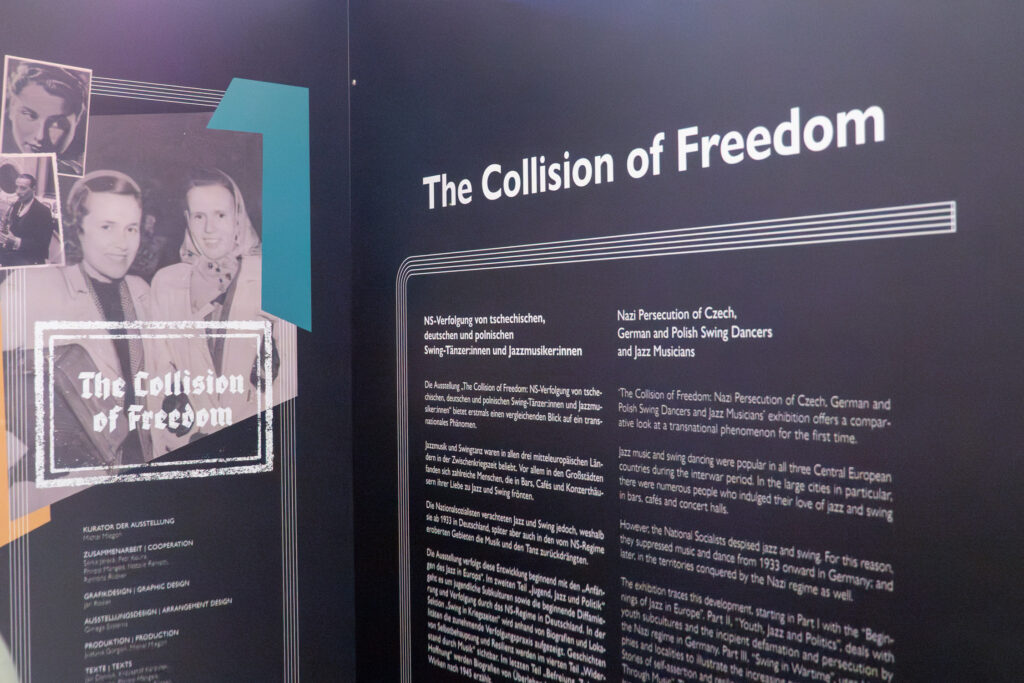
Exhibition “The Collision of Freedom”

The Collision of Freedom

Nazi Persecution of Czech, German and Polish Swing Dancers and Jazz musicians

The exhibition “The Collision of Freedom: Nazi Persecution of Czech, German and Polish Swing Dancers and Jazz Musicians” offers a comparative look at a transnational phenomenon for the first time.

Jazz music and swing dancing were popular in all three Central European countries during the interwar period. In the large cities in particular, there were numerous people indulging their love of jazz and swing in bars, cafés and concert halls. However, the National Socialists despised jazz and swing. For this reason they suppressed music and dance from 1933 onward in Germany; and later, in the territories conquered by the Nazi regime as well.

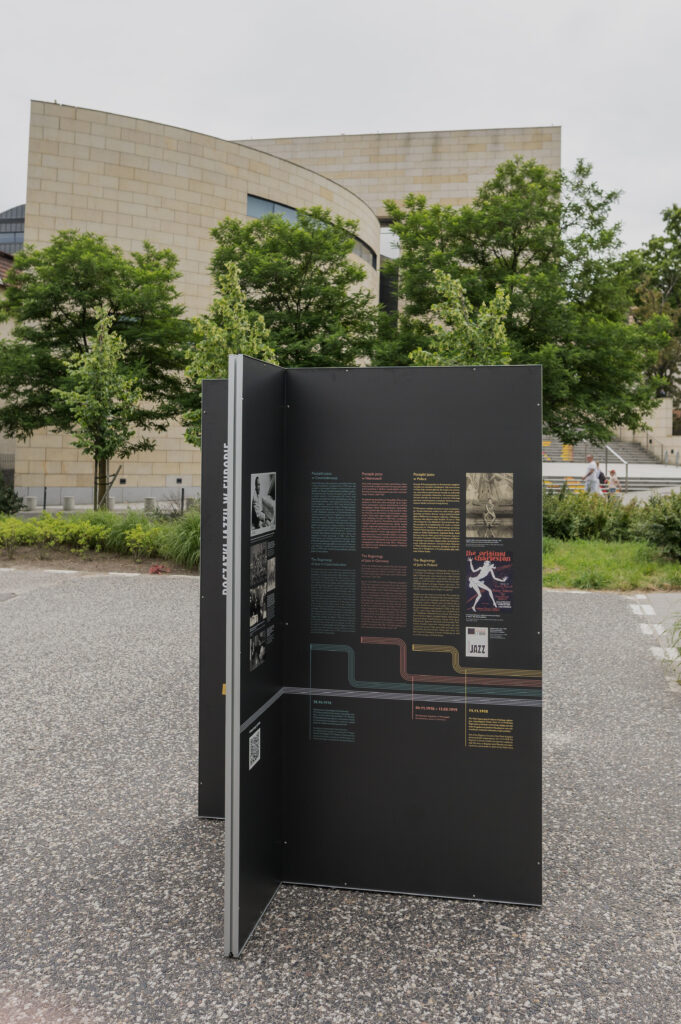
The exhibition traces this development, starting in Part I with the “Beginnings of Jazz in Europe”. Part II, “Youth, Jazz and Politics”, deals with youth subcultures and the incipient defamation and persecution by the Nazi regime in Germany. Part III, “Swing in Wartime”, uses biographies and localities to illustrate the increasing practice of persecution. Stories of self-assertion and resilience are revealed in Part IV, “Resistance Through Music”. The final Part V, “Liberation. Future. Hope”, recounts biographies of survivors and their continued work after 1945.

A chronology and different colors for each country allow the events to be placed in a broader, transnational context. Music tracks mentioned in the exhibition can be listened to via QR codes.

The exhibition consists of five modules, each with four interlocking partitions. Each partition wall measures 1.5m wide x 2.0m high.

The exhibition can be borrowed from the Bremer Bündnis für deutsch-tschechische Zusammenarbeit e.V. for a small insurance fee.

Contact person: Natalie Reinsch, reinsch@bremer-buendnis.de

So far, the exhibition has been shown at the following locations:

Gdynia (28.06.2025 – 07.09.2025)

Bremen (22.08.2025 – 14.09.2025)

Prague (27.09.2025 – 12.10.2025)

Photo: Paweł Jóźwiak
Photo: Philipp Mangels

Visit
us on Instagram

Exhibition “The Collision of Freedom” – Program in Bremen

Exhibition "The Collision of Freedom" - Program in Bremen

Photo: Paweł Jóźwiak

The Collision of Freedom

Nazi persecution of Czech, German and Polish swing dancers and jazz musicians

Trinational exhibition from August 22 to September 14, 2025

Gallery of the University of the Arts (HfK)
Dechanatstrasse 13-15
28195 Bremen

Accompanying program:

August 22, 7 p.m. Exhibition opening with partners from the Czech Republic and Poland, in the HfK gallery
Afterwards: live music by Jakub Šafr & swing trio Avalon with social dance, DJane Eléna Wendt (Swing Man Tau) until 11 pm
Venue: Gallery of the HfK

24 August, 3 p.m. Lecture by Dr. Šárka Jarská on the persecution of Czech jazz musicians and the Czech swing youth by the Nazi regime
Afterwards: Tea Dance
Venue: Evangelische Studierendengemeinde Oldenburg, Schützenweg 40, 26129 Oldenburg

September 5, from 7 p.m. Bremen Babylon Bohème, the dance night at Bali’Ku with original swing shellac records by DJ Guido Bolero
Venue: Bali’Ku, Werderstraße 60, 28199 Bremen

September 6 & 13 2 p.m. Swing Walk: City tour in the footsteps of Bremen’s swing youth
Meeting point: in front of City 46, Birkenstraße 1, 28195 Bremen

September 6, 7 p.m. Film screening “Django – A Life for Music”, preceded by a film discussion with Django Heinreich Reinhard and Giovanni Steinbach, moderated by Natalie Reinsch (BBfd-tZ)
Venue: Gallery of the HfK

September 10, 7 p.m. Theater performance: “Gegen das, was da oben ist” – a documentary collage with motifs from “Swinging Bremen” by Birgit Köhler with the performing arts course of Helene Finck (Altes Gymnasium Bremen)
Venue: Gallery of the HfK

September 12, 7 p.m. Talk about Sinti Swing with Dardo Balke and Nico Thom, followed by a concert by the Dardo Balke Ensemble with Social Dance
Venue: Gallery of the HfK

Click here for the program flyer

NS-Injustice "Degenerated Music"

The transnational project takes a comparative look at the Nazi persecution practices of the northwest German swing youth, the Czech potapki and the swing and jazz music scene in occupied Poland and develops multi-perspective, interdisciplinary and participatory mediation formats.

Logo NS_injustice

BBfd-tZ at DAS! – Researchers from Bremen about swing youth during the Nazi era
BBfd-tZ at DAS! - Researchers from Bremen about swing youth during the Nazi era

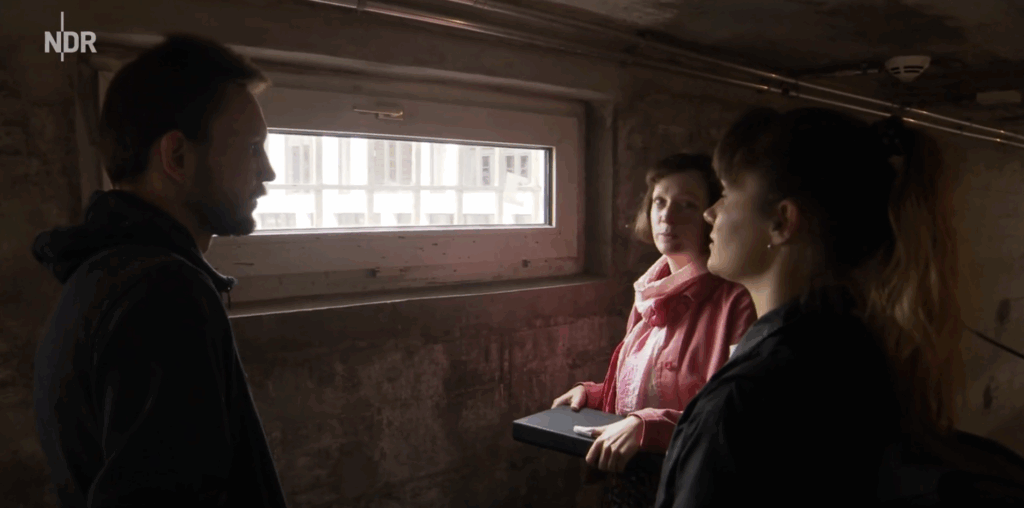
Swing and jazz were considered “degenerated music” by the National Socialists. But there was a scene of around 1,000 active music-loving young people in Hamburg who pursued swing. Conflicts with the Nazi regime were inevitable.
The NDR and the talk show DAS! accompanied three Bremen historians from the Bremer Bündnis für deutsch-tschechische Zusammenarbeit e.V., who are researching the topic of swing youth.

The content of this video is in German.

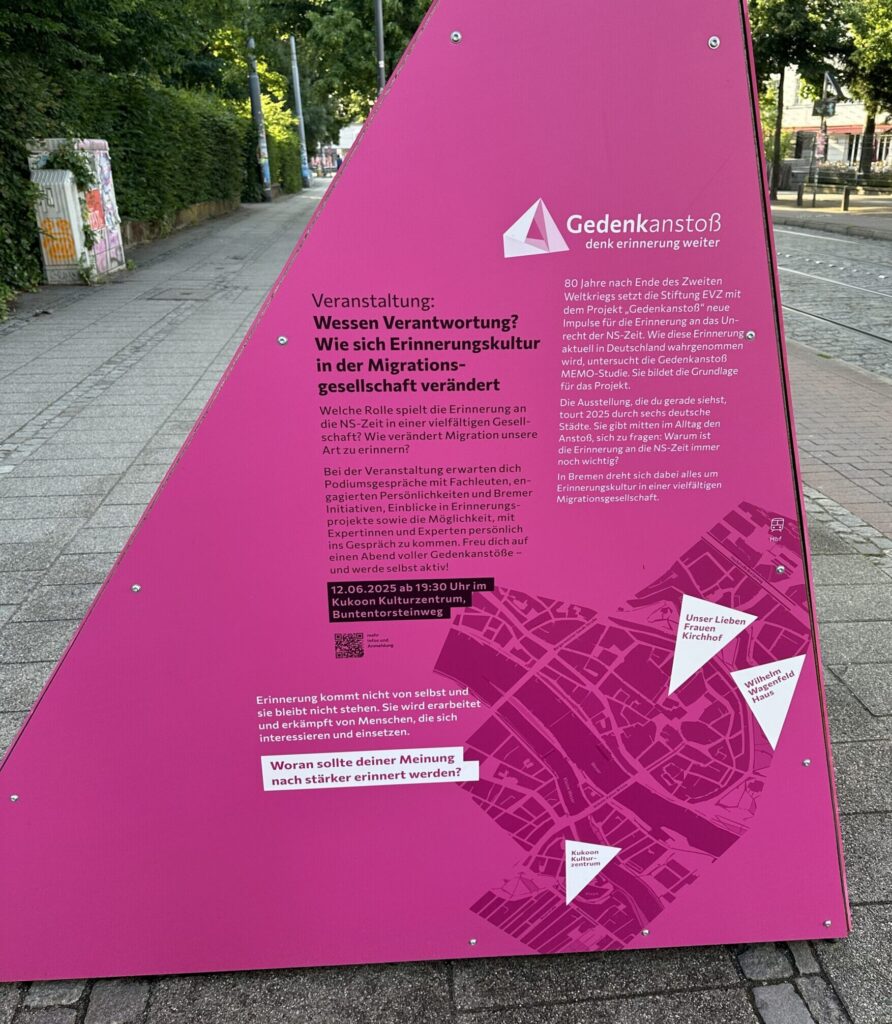
Event information: 12.06. Commemorative Impulse in Bremen
Event information: 12.06. Commemorative Impulse in Bremen

Photo: Ramona Rücker

When: Thursday, 12.06.2025, 19:30 h

Where: Kukoon Cultural Center, 28201 Bremen

With: Ksenja Holzmann (Landeszentrale für politische Bildung/Denkort Bunker Valentin) Virginie Kamche (Afrika Netzwerk), Derviş Hızarcı (Kreuzberger Initiative gegen Antisemitismus), Lucy Debus (trotzdem da!)

Commemorative kick-off in Bremen – Whose responsibility? How the culture of remembrance is changing in the migration society

What role does the memory of the Nazi era play in a diverse society? How does migration change the way we remember? 80 years after the end of the Second World War, the question of how we can all keep the memory alive is being discussed. The event will feature panel discussions with experts, committed personalities and Bremen initiatives, insights into remembrance projects and the opportunity to talk to experts in person.

We from the Bremen Alliance for German-Czech Cooperation are also taking part with our project “NS-Injustice ‘Degenerated Music’”. We look forward to presenting our Liberation Dance and to exchanging ideas at our stand.

Free admission. Please register for the event at: https://www.stiftung-evz.de/veranstaltungen/anmeldungen/anmeldung-gedenkanstoss-in-bremen/

NS-Injustice "Degenerated Music"

The transnational project takes a comparative look at the Nazi persecution practices of the northwest German swing youth, the Czech potapki and the swing and jazz music scene in occupied Poland and develops multi-perspective, interdisciplinary and participatory mediation formats.

Logo NS_injustice

08.05. Commemorative event: Liberation Dance, 6.00 p.m.
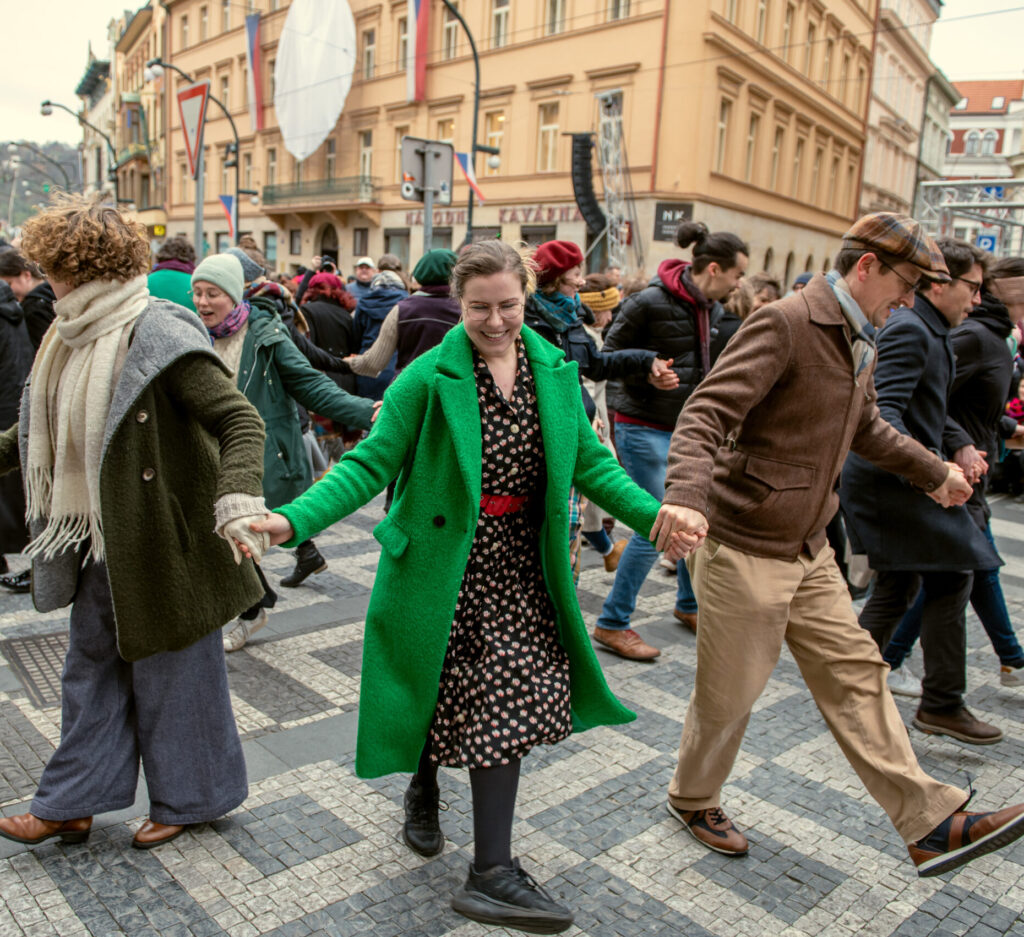
Commemorative event: Liberation Dance

Photo: Jiří Lubojacký

When: Thursday, 08.05.2025, 18:00 – 19:00 h

Where: Marketplace Bremen

Europe-wide flash mob to commemorate 80 years since the end of the Second World War

2025 marks the 80th anniversary of the end of the Second World War in Europe with the unconditional surrender of the German Wehrmacht.
It commemorates the liberation from National Socialism and the devastating war with over 60 million dead.

The Liberation Dance will be performed as a flash mob on May 8 as part of the tri-national project “Nazi injustice ‘Degenerate Music’. Persecuted swing dancers and jazz musicians in north-west Germany, the Czech Republic and Poland”.

The title “Jeepers Creepers” by Louis Armstrong was chosen because German swing youths sang it during forced labor in concentration camps, as they were persecuted by the Nazi regime because of their love of jazz and swing.

The Liberation Dance was conceived in Bremen together with dancers from all over Europe in remembrance of the war, but also in view of the strengthening of right-wing groups throughout Europe.

Dancing the choreography together, holding hands and building bridges, which can be recognized in the dance, stands for cohesion, for remembrance, because #Niewiederistjetzt

NS-Injustice "Degenerated Music"

The transnational project takes a comparative look at the Nazi persecution practices of the northwest German swing youth, the Czech potapki and the swing and jazz music scene in occupied Poland and develops multi-perspective, interdisciplinary and participatory mediation formats.

Logo NS_injustice